
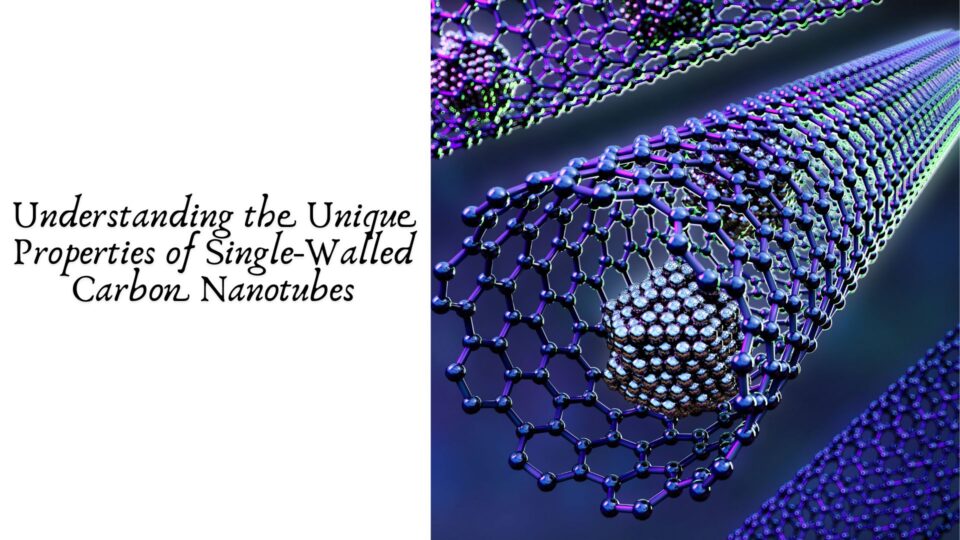
Single walled carbon nanotubes (SWCNTs) are among the most remarkable nanomaterials developed through modern materials science. Their combination of nanoscale dimensions, high aspect ratio, low density, mechanical strength, electrical characteristics, thermal behavior, and optical properties has made them important in research across electronics, energy, sensing, advanced composites, and nanotechnology.
A single-walled carbon nanotube can be understood as a single sheet of graphene rolled into a seamless cylindrical structure. Although this description sounds simple, the precise way the graphene sheet is rolled determines the nanotube’s atomic structure and many of its resulting properties. In particular, parameters such as diameter and chirality can determine whether a nanotube behaves more like a metal or a semiconductor.
This structural tunability is one of the main reasons SWCNTs continue to attract scientific and technological interest. Researchers have developed synthesis and separation techniques to obtain nanotubes with more controlled diameter, conductivity type, and chirality for specialized applications.
Single-walled carbon nanotubes are cylindrical nanostructures consisting of a single carbon wall. The wall is formed from carbon atoms arranged in a hexagonal lattice similar to graphene. The cylindrical structure can have a very small diameter compared with its length, giving SWCNTs an exceptionally high aspect ratio.
The carbon atoms are connected through strong sp²-type bonding. This atomic arrangement contributes to the nanotubes‘ distinctive mechanical, electrical, thermal, and optical behavior.
SWCNTs differ from multi-walled carbon nanotubes (MWCNTs) because MWCNTs contain multiple concentric carbon nanotube walls, whereas an SWCNT consists essentially of one cylindrical carbon wall. This structural difference can significantly influence dispersion, surface interactions, electronic characteristics, and suitability for particular applications.
One of the most important concepts for understanding SWCNTs is chirality.
The graphene lattice can be conceptually rolled in different directions to form a nanotube. The direction in which it is rolled is represented by a pair of integers, commonly written as (n,m). This pair defines the nanotube’s chiral structure.
Different chiralities can produce nanotubes with different electronic and optical characteristics. Some SWCNTs exhibit metallic behavior, while others behave as semiconductors. Consequently, chirality is not simply a geometric characteristic—it is closely connected to the functional behavior of the material.
This is particularly important when SWCNTs are being considered for electronic or optoelectronic devices. Researchers therefore continue to investigate methods for producing and separating nanotubes according to conductivity type and specific chirality.
Electrical behavior is one of the most widely studied characteristics of single-walled carbon nanotubes.
Because of their one-dimensional electronic structure, SWCNTs can demonstrate highly distinctive charge-transport behavior. Depending on their atomic configuration, they may behave as metallic conductors or semiconductors.
Individual SWCNTs can exhibit very high electrical conductivity, although the conductivity of a bulk nanotube material depends on factors such as nanotube alignment, purity, contacts, defects, tube-to-tube junctions, and processing conditions. Recent research emphasizes that the outstanding conductivity of individual nanotubes does not simply translate directly into equivalent bulk conductivity.
These characteristics make SWCNTs attractive for research involving:
The ability to separate metallic and semiconducting SWCNTs is particularly valuable when designing devices that require predictable electrical behavior.
SWCNTs are also known for their remarkable mechanical characteristics.
The strong carbon-carbon bonding within their graphene-like walls contributes to high stiffness and strength at the individual nanotube level. Their lightweight structure and high aspect ratio make them attractive as reinforcing components in advanced materials.
When incorporated into a suitable polymer or other matrix, SWCNTs can contribute to improvements in mechanical performance, electrical functionality, or both. The resulting composite properties depend on factors such as nanotube dispersion, alignment, concentration, interfacial bonding, and processing.
Potential applications include:
The mechanical behavior of nanotube networks can also differ from that of individual nanotubes because interactions between nanotubes influence the overall structure.
Single-walled carbon nanotubes also exhibit interesting thermal characteristics.
The carbon lattice provides a pathway for heat transport along the nanotube axis. Thermal behavior can depend on nanotube structure, defects, interactions with neighboring nanotubes, and the surrounding material.
This makes SWCNTs interesting for research into thermal-management materials and multifunctional composites.
Potential areas include:
However, practical thermal performance depends heavily on how nanotubes are assembled into a larger material. Individual nanotube properties and bulk-material properties should therefore be distinguished.
SWCNTs have highly interesting optical properties that arise from their one-dimensional electronic structure.
Semiconducting SWCNTs can interact strongly with light, and their optical transitions depend on factors such as diameter and chirality. This provides opportunities for wavelength-selective optical and optoelectronic technologies.
Research has explored SWCNTs for:
The ability to control or separate nanotubes according to their structural characteristics is particularly valuable in optical applications because different nanotube species can exhibit different optical responses.
The nanoscale diameter and extended cylindrical structure of SWCNTs result in a large surface area relative to their volume.
This surface is important because molecules and other materials can interact with the nanotube sidewall. By modifying the surface chemistry, researchers can influence dispersion, molecular interactions, sensing behavior, and compatibility with other materials.
This characteristic makes SWCNTs attractive for sensor development.
For example, nanotube-based sensors can be designed to respond to changes in their surrounding environment. Interaction with specific chemical species can influence the electrical or optical response of the nanotube system.
Research areas include:
Unlike conventional bulk materials, SWCNTs have an extremely confined geometry.
Their one-dimensional electronic structure produces properties that are fundamentally different from those of many three-dimensional materials. This makes SWCNTs valuable not only as engineering materials but also as platforms for studying nanoscale and quantum-related phenomena.
The electronic states are strongly influenced by nanotube structure, particularly chirality and diameter. This structural dependence allows researchers to investigate relationships between atomic-scale geometry and macroscopic device performance.
Another important advantage of SWCNTs is their combination of low density and extremely high aspect ratio.
A small quantity of nanotubes can create extended conductive or reinforcing pathways when they are properly distributed within a host material. This is particularly useful in composite applications where maintaining low weight is important.
For example, SWCNTs can potentially provide electrical functionality without requiring large quantities of conventional conductive fillers.
Their high aspect ratio also influences network formation, percolation behavior, mechanical reinforcement, and interaction with surrounding materials.
While SWCNTs possess remarkable intrinsic properties, their practical performance is strongly affected by structural quality.
Defects in the carbon lattice can alter electrical, optical, mechanical, and chemical behavior. Impurities, catalyst residues, amorphous carbon, nanotube bundles, and mixtures of different nanotube structures can also affect performance.
Consequently, purification and characterization are important steps in many SWCNT applications.
Researchers use techniques such as spectroscopy, microscopy, chromatography, centrifugation, and electrical characterization to study nanotube composition and quality. Separation methods can distinguish metallic and semiconducting nanotubes and, in some cases, isolate specific chirality populations.
A major practical consideration is how SWCNTs behave when incorporated into liquids, polymers, coatings, or other materials.
Because carbon nanotubes can interact strongly with one another, they may form bundles or aggregates. Poor dispersion can reduce the ability of individual nanotubes to contribute their intrinsic properties to the final material.
Functionalization can be used to modify the nanotube surface and improve compatibility with selected matrices or solvents. However, chemical modification can also alter the nanotube’s intrinsic properties.
Therefore, SWCNT processing often requires a balance between:
Electronics is one of the most important areas of SWCNT research.
Semiconducting SWCNTs have been investigated for field-effect transistors and other nanoscale electronic devices. Their small dimensions and distinctive electronic properties offer possibilities for miniaturized components and flexible electronics.
SWCNT networks can also be used in conductive and transparent films. Their electrical conductivity, mechanical flexibility, and optical transparency can be useful when developing flexible or lightweight electronic materials.
Potential applications include:
SWCNTs are promising sensing materials because their electronic properties can respond to interactions with molecules in their environment.
A target molecule attaching to or interacting with a nanotube surface can modify the local electronic environment. This may produce a measurable change in electrical characteristics.
SWCNT-based sensors have therefore been investigated for chemical, biological, and environmental detection.
Their nanoscale dimensions and high surface-to-volume ratio make them particularly interesting for applications where detecting small quantities of material is important.
The distinctive electrical and structural characteristics of SWCNTs have also encouraged research in energy technologies.
SWCNTs have been explored as conductive components, network-forming materials, and structural additives in energy-storage and energy-conversion systems.
Potential research areas include:
Their role can vary significantly depending on the material system. In many cases, SWCNTs are used as part of a composite rather than as the sole active material.
SWCNTs are particularly interesting for optoelectronic research because their electronic and optical properties are closely connected to their nanoscale structure.
Chirality-separated semiconducting nanotubes can provide more uniform optical responses than mixtures containing many different nanotube structures. Research has explored their use in light emission, photodetection, and other optoelectronic systems.
This structural tunability is one reason researchers continue to investigate methods for producing highly controlled SWCNT populations.
SWCNTs have also been investigated in biomedical research, including bioimaging and sensing.
Their optical characteristics can be useful for developing imaging approaches, while their nanoscale dimensions provide opportunities for interactions with biological systems.
However, biomedical applications require careful consideration of surface chemistry, purity, dispersion, biological compatibility, and safety. The suitability of a particular SWCNT material depends on its physical and chemical characteristics as well as the intended application.
Several techniques can be used to produce SWCNTs. Chemical vapor deposition (CVD) is among the important approaches investigated for nanotube synthesis, while other methods include laser-based and arc-based techniques.
A major challenge is controlling the resulting nanotube population.
A typical synthesis can produce SWCNTs with different:
Because different applications may require specific nanotube characteristics, researchers have developed post-synthesis separation and purification techniques. These include density-gradient ultracentrifugation, chromatography, electrophoresis, selective solubilization, and other approaches.
The performance of an SWCNT-based material depends not only on the intrinsic properties of carbon nanotubes but also on the quality of the supplied material.
For example, an electronic application may require a high proportion of semiconducting nanotubes, while a conductive network may benefit from metallic nanotubes or a carefully controlled mixture.
Similarly, applications involving optical measurements can require relatively narrow distributions of nanotube structures.
Purity, dispersion, length distribution, defect density, catalyst residues, and chirality distribution can therefore be important specifications when selecting SWCNT materials.
Carbon exists in many nanoscale forms, including graphene, fullerenes, carbon nanoparticles, and multi-walled carbon nanotubes.
SWCNTs occupy a distinctive position because they combine a graphene-like carbon lattice with a one-dimensional tubular geometry.
Compared with graphene, SWCNTs provide a highly elongated one-dimensional structure. Compared with MWCNTs, SWCNTs have a single carbon wall and therefore offer a more structurally defined system for studying chirality-dependent properties.
This structural precision is particularly valuable for fundamental research and applications requiring controlled electronic or optical characteristics.
Despite their impressive properties, SWCNTs are not a universal replacement for conventional materials.
Several challenges remain:
Producing large quantities of nanotubes with precisely controlled chirality remains challenging. Researchers continue to develop controlled synthesis and sorting methods.
Removing catalyst particles, amorphous carbon, and unwanted nanotube structures can be important for high-performance applications.
SWCNTs can aggregate or form bundles, making uniform incorporation into a matrix difficult.
Converting individual nanotube properties into reliable bulk-material performance requires careful control of alignment, contacts, interfaces, and network structure.
Producing highly uniform and application-specific SWCNT materials at commercially useful scales remains an active research area.
Recent research continues to emphasize the importance of purity and processability when moving SWCNTs toward practical electronic materials.
The future of single-walled carbon nanotubes is closely connected to improved control over their structure and processing.
Rather than simply producing larger quantities of nanotubes, researchers are increasingly interested in producing nanotubes with specific characteristics for specific applications.
This includes:
Recent research has also explored highly controlled SWCNT assemblies for advanced optoelectronic architectures, demonstrating continued interest in combining structural uniformity with device engineering.
Single-walled carbon nanotubes are exceptional nanomaterials because their unique properties originate directly from their atomic structure. Their high aspect ratio, low density, mechanical characteristics, electrical behavior, thermal properties, optical response, and large surface-to-volume ratio make them valuable for a broad range of scientific and technological applications.
One of the most important features of SWCNTs is the relationship between structure and performance. Diameter and chirality can strongly influence electronic and optical behavior, while purity, defects, dispersion, alignment, and processing determine how effectively those intrinsic properties translate into practical materials and devices.
From flexible electronics and sensors to energy technologies, transparent conductive films, optoelectronics, and advanced composites, SWCNTs continue to provide opportunities for developing next-generation materials. As synthesis, purification, sorting, and processing technologies improve, more precisely engineered single-walled carbon nanotubes may become increasingly useful across advanced materials research and commercial nanotechnology.
For researchers, engineers, and manufacturers exploring nanoscale carbon materials, understanding the unique properties of SWCNTs is an important step toward selecting and designing materials for specific applications.